 Preferred Store:
 My Account Sign-In







Sign-up for {N}power to get exclusive discounts, newsletters, members-only features, and more!
If black seed oil were a cartoon superhero, it would save the world with its signature super phytonutrient constituent, thymoquinone, a powerful free radical scavenger. When you take black seed oil, thymoquinone springs into action and unleashes its power on everyday “villains” in the most immune-supporting, allergy-relieving, inflammatory-modulating, cardiovascular-protecting, and blood-sugar balancing of ways. But rather than fighting fictional villains, black seed oil fights very real, everyday threats in the form of health-hindering ailments.
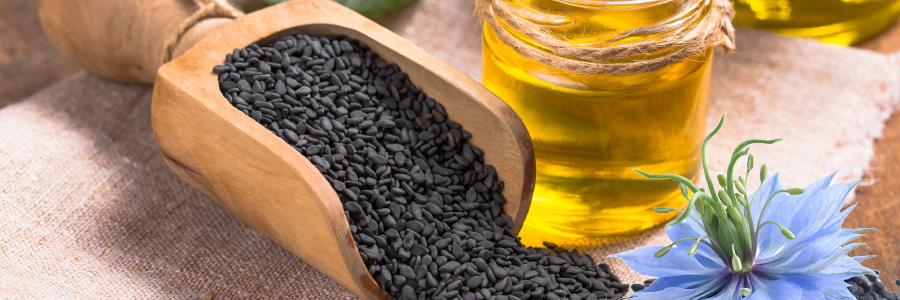

Black seed oil (also called black caraway and black cumin seed) provides powerful support to the immune system. It’s an immune modulator, keeping the immune system in balance so it doesn’t overreact or underreact. Black seed oil also quenches dangerous inflammation and boosts appropriate immune function, resulting in enhanced protection against infections, while it also eases coughs, bronchitis symptoms, and colds.1 2 3 New research is showing that via its immune-regulatory, anti-inflammatory, and antioxidant benefits, black seed oil is a powerful immune ally, especially when it comes to respiratory health.4 5
Approximately 18 million Americans suffer from allergies, and close to 19 million suffer from asthma. These conditions can range from sheer annoyance to debilitating and life threatening. Studies show that thymoquinone produces a sharp reduction in inflammatory molecules that play a role in both asthma- and allergy-related symptoms.67 A study of patients with allergic rhinitis produced promising results, showing that treatment with black seed oil resulted in a drastic decrease in IgE antibodies (antibodies that indicate an allergic response) in nasal secretions, as well as significant reductions in nasal congestion and itching, runny nose, and sneezing attacks.8

Studies also show that black seed oil is a force to be reckoned with when it comes to managing asthma. Black seed oil and thymoquinone itself, “trigger relaxation of the trachea and large airways (bronchi), both of which can go into spasm during an asthma attack.”9 10 Furthermore, a study of mice treated with black seed oil found reduced numbers of inflammatory cells in their lung tissue, “equivalent to those induced by dexamethasone, a potent, immune-suppressing steroid.”11
Another study showed that taking black seed oil for acute tonsillitis and sore throat, infections that are often viral in nature, significantly alleviated throat pain and reduced the need for pain killers.12 Black seed oil also shines in the treatment of sinusitis. The results from one study showed its therapeutic potential in the treatment of sinusitis by its “…anti-inflammatory, antioxidant, antihistaminic, immune-modulator, antimicrobial, and analgesic effects. The oil can inhibit the inflammation of sinuses and respiratory airways, microbial infections, and finally help the patients suffering from clinical symptoms of sinusitis such as … nasal congestion, headache, neck pain, earache, and toothache,” according to the study’s findings.13

Black seed oil neutralizes lipid (fat) oxidation and reduces the impact of oxidized LDL cholesterol, a major trigger for the atherosclerotic plaques that block blood flow and cause heart attacks and strokes.14 Studies have shown that black seed oil can improve the lipid profile and prevent cardiovascular diseases in both healthy people and hyperlipidemic patients. Hyperlipidemia is a condition in which there are high levels of fat particles, such as cholesterol and triglycerides, in the blood.15 It’s thought that black seed oil benefits cardiovascular health in part by inhibiting the absorption of cholesterol in the intestines and decreasing cholesterol production in the liver.16
Black seed oil also reduces high blood pressure. Results from a double-blind, eight-week study looking at the effects of N. sativa oil on hypertension showed that, at 2.5 mL twice a day, the oil-treated group had significantly decreased systolic and diastolic numbers compared with the baseline and placebo group at the end of the trial, without any adverse effects.17
Black seed oil, in combination with anti-diabetic drugs and statins, can also help diabetic patients control both dyslipidemia (abnormal levels of cholesterol or lipids in the blood) and blood sugar.18 A review of 13 clinical trials on the hypoglycemic effect of black seed oil, eight of which included patients with insulin resistance, found that the use of black seed decreased fasting blood sugar, insulin levels, and insulin resistance.19 20
A common risk factor for cardiovascular disease is also body weight and one’s overall metabolic profile. A double-blind, randomized controlled trial of 90 obese women taking either black seed oil or a placebo for eight weeks resulted in significantly decreased weight and waist circumference in the women taking black seed oil compared to the placebo group. There was also a significant decline in triglyceride and LDL cholesterol levels in the black seed oil group compared to the placebo group.21
With its wide-ranging health benefits, black seed oil is worth adding to your supplement repertoire, so it can come to the rescue whenever you need it!
Sign-up for {N}power to get exclusive discounts, newsletters, members-only features, and more!