 Preferred Store:
 My Account Sign-In






Sign-up for {N}power to get exclusive discounts, newsletters, members-only features, and more!
Our love of grapes spans across almost all of human history. Ancient Egyptians, Romans, Greeks, and many other early civilizations all showed their reverence for the vine, depicting grapes in art, ritual, and song as symbols of leisure, luxury, fertility, and harbingers of good luck. In more recent traditions, Spanish legend has it that eating 12 grapes at midnight on New Year’s Eve brings good luck for the year ahead, one grape for every month. We say, why wait until New Year’s? And why not have a few extra, too?
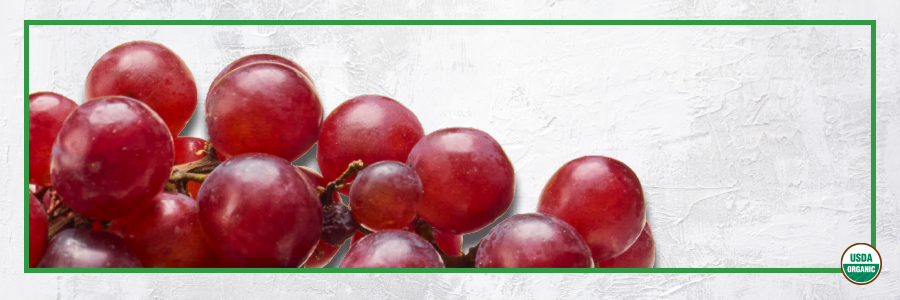
Grapes came in as fourth most at risk for pesticide residues in the 2026 Environmental Working Group’s (EWG) Dirty Dozen list.1 While grapes showed a range of pesticide residues, grapes in their dried form—raisins—were even more contaminated. The Dirty Dozen list focuses on fresh produce, so raisins are not included, but when the results from the USDA’s tests on raisins came in, the EWG couldn’t help but take notice. “Raisins are one of the dirtiest commodities on the market” Dr. Thomas Galligan, former EWG toxicologist writes.2 If raisins were included in the Dirty Dozen list, they would take the top spot, with 99 percent of samples showing at least two pesticides. Samples were contaminated with an average of 13 pesticides.
Part of what makes raisins even more of a risk for contamination with pesticides compared to fresh grapes is the processing: conventional grapes are dried, then fumigated with toxic gases that can leave residues.3 Fumigants are banned in organic farming, making organic raisins (and grapes!) an easy choice.
A swirl of the stemmed glass, a deep breath, and a small sip. Ah, fruity with notes of oak and… PFAS?! Per-and-polyfluoroalkyl substances (PFAS), commonly known as ‘forever chemicals,’ are a toxic group of substances linked with serious health and environmental risks. Some of the health dangers include immune dysfunction, increased risk of various cancers, and reproductive and developmental harms.5 An EWG analysis found that 2.5 million pounds of pesticides sprayed on California farms are considered PFAS.6 Wine grapes are one of the most heavily PFAS-sprayed crops in the state. A seven-year study in France found that children living near vineyards (within 0.6 miles), had increased risk of lymphoblastic leukaemia where vineyards were denser.7, 8 Organic wine farms on the other hand, help keep PFAS out of our communities and out of our wine so the red, red wine can stay close at hand!
They say, “A glass of wine a day keeps the doctor away.” That’s how the saying goes… right? While it may actually be apples keeping doctors away, there is something to the health- supporting nutrients in grapes—yes, wine included—and resveratrol is one of its standout compounds. Resveratrol is found in grape skins, berries, cocoa, and some nuts, and is well-known for its benefits to cardiovascular health, cognitive function, eye health, and skin health.9, 10 A handful of studies over the last six years have investigated the benefits of resveratrol for preventing and treating COVID-19 and its lingering impacts in long-COVID. So far, studies have found promising results for its ability to fight particular effects of the disease, including lung inflammation and cardiovascular risks, and even to prevent the COVID virus from replicating.11, 12 Resveratrol in organic grapes has been shown to be more bioavailable than that in conventional grapes.13
In any form, whether straight from the vine, or as jelly, juice, or wine, cheers to all the ways organic grapes support our health!
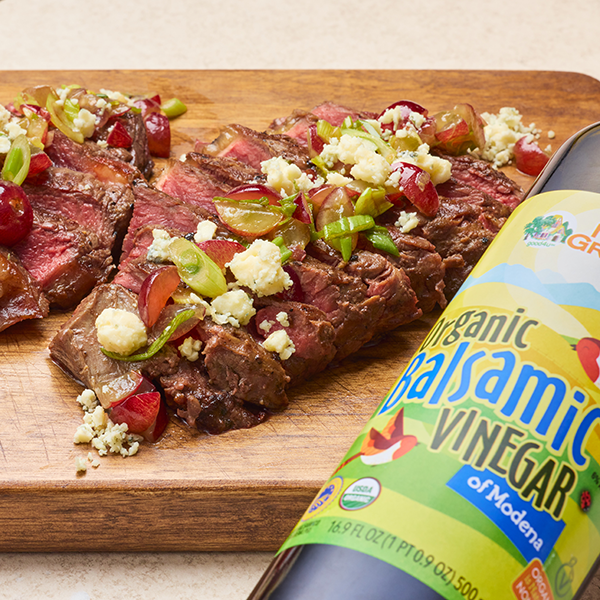
Steak is an easy choice for a quick weeknight meal and with a simple marinade and a fresh relish, it can be elevated to an entirely new level of flavor. Our Balsamic Steak with Grape Relish is rich, juicy, and full of depth. The marinade infuses the steak with bold savory notes, and once grilled to perfection, the steaks are topped with a sweet, savory, and tangy relish, resulting in a perfectly balanced dish that feels both effortless and elevated.
Sign-up for {N}power to get exclusive discounts, newsletters, members-only features, and more!