Protein Across the Lifespan
Protein plays an important role at every stage of life. During pregnancy, it helps support a growing baby; in childhood, it fuels growth and strengthens the immune system; in adulthood, it helps maintain lean muscle; and in later years, it can make a real difference in preserving strength and mobility and reducing frailty.3 4 5 6 The issue isn’t protein itself—it arises when intake exceeds balanced levels and isn’t paired with minerals and other alkalizing nutrients from vegetables.
The Acid Load Issue: Why Balance Matters
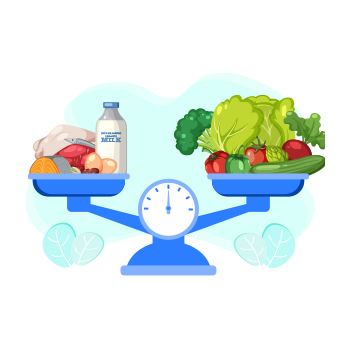
Protein produces acidic byproducts during metabolism. Diets high in these foods raise dietary acid load, typically measured by Potential Renal Acid Load (PRAL).7 The body carefully maintains pH balance with buffering minerals such as calcium, magnesium, and potassium, but when these minerals are insufficient, particularly when vegetable intake is low, the body may leach calcium from bone to compensate, weakening them over time.8 9 10 Additionally, diets very high in protein may impair kidney function over time, especially in those already experiencing kidney dysfunction or disease.11
The answer? Eat more veggies! A recent systematic review and meta-analysis found that people who ate five or more servings of vegetables and fruit per day—a diet pattern that lowers PRAL scores—had a significantly lower risk of hip fractures, which are linked to loss of independence, reduced mobility, and even higher mortality, compared with those who ate few vegetables and fruits, supporting the idea that vegetables and fruits, which are alkalizing, help protect bone health.12 13 14
Dietary patterns that include adequate—but not excessive—protein and sufficient vegetables and fruit are also associated with improved kidney outcomes and slower decline in kidney function, particularly in aging populations and those at risk for chronic kidney disease.15 16
Bridging Protein and Vegetables
Protein is crucial for bone health because it builds the collagen matrix that gives bones their structure and allows minerals to be deposited; however, protein’s bone benefits depend on sufficient intake of minerals, found largely in vegetables and fruits.17 Non-starchy vegetables are especially rich in minerals and contain alkalizing compounds that help neutralize dietary acid, supporting both bone and kidney health.18 Leafy greens, cruciferous vegetables, and colorful produce also provide fiber, antioxidants, and phytonutrients that support overall health.19 20
Research shows that diets higher in fruits and vegetables are associated with lower PRAL scores and more favorable markers of mineral balance, even when protein intake is relatively high,21 and a recent study showed that diets rich in high-quality carbohydrates—particularly vegetables—are associated with lower risk of cardiovascular disease, type-2 diabetes, cancer, cognitive decline, and all-cause mortality.22 23 Fiber-rich diets that are high in vegetables and fruits also support the production of short-chain fatty acids that regulate inflammation, insulin sensitivity, and bone metabolism.24
Recent systematic reviews indicate that higher protein intake is associated with neutral or beneficial bone outcomes when mineral and vegetable intake are sufficient, but may be less favorable when fruits and vegetables are lacking.25 In fact, populations with lower fracture risk tend to consume both adequate protein and abundant vegetables—underscoring the importance of a balanced diet.26 27
Rethinking the Plate
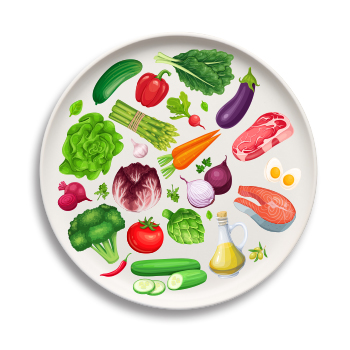
Instead of building meals around protein alone, support a balanced approach:
- Fill at least half of your plate with non-starchy vegetables28
- Include moderate portions of high-quality animal protein29
- Include healthy fats to support nutrient absorption and provide essential micronutrients30
Protein is essential from conception to old age, but more is not always better. When protein intake increases without an abundant intake of vegetables, bone and kidney health may be compromised over time. The solution is simple and evidence-based: pair protein with plenty of vegetables to avoid the unintended trade-offs. The protein craze doesn’t need to disappear—it just needs more veggies. Protein powers your body, vegetables help it do its job safely.
References
- Gobel, R. (2025, July 19). Are high-protein snacks worth the hype? Here’s how to assess. NPR. https://www.npr.org/2025/07/19/nx-s1-5470245/high-protein-snacks-bars-f…
- Wieërs MLAJ, Beynon-Cobb B, Visser WJ, Attaye I. Dietary acid load in health and disease. Pflugers Arch. 2024 Apr;476(4):427-443. doi: 10.1007/s00424-024-02910-7. Epub 2024 Jan 29. PMID: 38282081; PMCID: PMC11006742.
- Escobedo-Monge, M. F., Parodi-Román, J., Escobedo-Monge, M. A., & Marugán-Miguelsanz, J. M. (2025). The Biological Value of Proteins for Pediatric Growth and Development: A Narrative Review. Nutrients, 17(13), 2221. https://doi.org/10.3390/nu17132221
- Carbone JW, Phillips SM, Weaver CM, Hughes JM, Pasiakos SM. Exploring Opportunities to Better Characterize the Effects of Dietary Protein on Health across the Lifespan. Adv Nutr. 2025 Jan;16(1):100347. doi: 10.1016/j.advnut.2024.100347. Epub 2024 Nov 26. PMID: 39608572; PMCID: PMC11699594.
- Coelho-Junior HJ, Marzetti E, Picca A, Cesari M, Uchida MC, Calvani R. Protein Intake and Frailty: A Matter of Quantity, Quality, and Timing. Nutrients. 2020 Sep 23;12(10):2915. doi: 10.3390/nu12102915. PMID: 32977714; PMCID: PMC7598653.
- Mousa A, Naqash A, Lim S. Macronutrient and Micronutrient Intake during Pregnancy: An Overview of Recent Evidence. Nutrients. 2019 Feb 20;11(2):443. doi: 10.3390/nu11020443. PMID: 30791647; PMCID: PMC6413112.
- Wieërs MLAJ, Beynon-Cobb B, Visser WJ, Attaye I. Dietary acid load in health and disease. Pflugers Arch. 2024 Apr;476(4):427-443. doi: 10.1007/s00424-024-02910-7. Epub 2024 Jan 29. PMID: 38282081; PMCID: PMC11006742.
- Storz MA, Ronco AL, Hannibal L. Observational and clinical evidence that plant-based nutrition reduces dietary acid load. Journal of Nutritional Science. 2022;11:e93. doi:10.1017/jns.2022.93
- Abate, V., Vergatti, A., Altavilla, N., Garofano, F., Salcuni, A. S., Rendina, D., De Filippo, G., Vescini, F., & D’Elia, L. (2024). Potassium Intake and Bone Health: A Narrative Review. Nutrients, 16(17), 3016. https://doi.org/10.3390/nu16173016
- Frassetto L, Remer T, Banerjee T. Dietary Contributions to Metabolic Acidosis. Adv Chronic Kidney Dis. 2022 Jul;29(4):373-380. doi: 10.1053/j.ackd.2022.03.008. PMID: 36175075.
- Ko, G. J., Rhee, C. M., Kalantar-Zadeh, K., & Joshi, S. (2020). The Effects of High-Protein Diets on Kidney Health and Longevity. Journal of the American Society of Nephrology : JASN, 31(8), 1667–1679. https://doi.org/10.1681/ASN.2020010028
- Mirzababaei A, Daneshvar M, Basirat V, Asbaghi O, Daneshzad E. Association between dietary acid load and risk of osteoporotic fractures in adults: a systematic review and meta-analysis of observational studies. BMC Musculoskelet Disord. 2025 Mar 17;26(1):266. doi: 10.1186/s12891-025-08495-1. PMID: 40091014; PMCID: PMC11912693.
- Veronese N, Kolk H, Maggi S. Epidemiology of Fragility Fractures and Social Impact. 2020 Aug 21. In: Falaschi P, Marsh D, editors. Orthogeriatrics: The Management of Older Patients with Fragility Fractures [Internet]. 2nd edition. Cham (CH): Springer; 2021. Chapter 2. Available from: https://www.ncbi.nlm.nih.gov/books/NBK565577/ doi: 10.1007/978-3-030-48126-1_2
- Andaloro, S., Cacciatore, S., Risoli, A., Comodo, R. M., Brancaccio, V., Calvani, R., Giusti, S., Schlögl, M., D’Angelo, E., Tosato, M., Landi, F., & Marzetti, E. (2025). Hip Fracture as a Systemic Disease in Older Adults: A Narrative Review on Multisystem Implications and Management. Medical Sciences, 13(3), 89. https://doi.org/10.3390/medsci13030089
- Scialla JJ, Anderson CA. Dietary acid load: a novel nutritional target in chronic kidney disease? Adv Chronic Kidney Dis. 2013 Mar;20(2):141-9. doi: 10.1053/j.ackd.2012.11.001. PMID: 23439373; PMCID: PMC3604792.
- Banerjee, Tanushree1; McCulloch, Charles E.2; Crews, Deidra C.3,4; Burrows, Nilka Rios5; Pavkov, Meda E.5; Saran, Rajiv6; Morgenstern, Hal7; Bragg-Gresham, Jennifer6; Powe, Neil R.8,* for the Centers for Disease Control and Prevention Chronic Kidney Disease Surveillance Team. Proinflammatory Diets and Risk of ESKD in US Adults with CKD. Kidney360 3(11):p 1852-1860, November 24, 2022. | DOI: 10.34067/KID.0000442022
- Rizzoli R, Chevalley T. Nutrition and Osteoporosis Prevention. Curr Osteoporos Rep. 2024 Dec;22(6):515-522. doi: 10.1007/s11914-024-00892-0. Epub 2024 Sep 25. PMID: 39322861; PMCID: PMC11499541.
- 3 Methodological Considerations." National Academies of Sciences, Engineering, and Medicine. 2019. Dietary Reference Intakes for Sodium and Potassium. Washington, DC: The National Academies Press. doi: 10.17226/25353.
- Jay J Cao, James N Roemmich, Xiaoming Sheng, Lisa Jahns, Increasing Vegetable Intake Decreases Urinary Acidity and Bone Resorption Marker in Overweight and Obese Adults: An 8-Week Randomized Controlled Trial, The Journal of Nutrition, https://doi.org/10.1093/jn/nxab255.
- Wieërs MLAJ, Beynon-Cobb B, Visser WJ, Attaye I. Dietary acid load in health and disease. Pflugers Arch. 2024 Apr;476(4):427-443. doi: 10.1007/s00424-024-02910-7. Epub 2024 Jan 29. PMID: 38282081; PMCID: PMC11006742.
- Storz, M. A., Ronco, A. L., & Hannibal, L. (2022). Observational and clinical evidence that plant-based nutrition reduces dietary acid load. Journal of Nutritional Science, 11, e93. doi:10.1017/jns.2022.93
- Reynolds A, Mann J, Cummings J, Winter N, Mete E, Te Morenga L. Carbohydrate quality and human health: a series of systematic reviews and meta-analyses. Lancet. 2019 Feb 2;393(10170):434-445. doi: 10.1016/S0140-6736(18)31809-9. Epub 2019 Jan 10. Erratum in: Lancet. 2019 Feb 2;393(10170):406. doi: 10.1016/S0140-6736(19)30119-9. PMID: 30638909.
- Ardisson Korat AV, Duscova E, Shea MK, et al. Dietary Carbohydrate Intake, Carbohydrate Quality, and Healthy Aging in Women. JAMA Netw Open. 2025;8(5):e2511056. doi:10.1001/jamanetworkopen.2025.11056
- Tao Zhou, Mengying Wang, Hao Ma, Xiang Li, Yoriko Heianza, Lu Qi, Dietary Fiber, Genetic Variations of Gut Microbiota-derived Short-chain Fatty Acids, and Bone Health in UK Biobank, The Journal of Clinical Endocrinology & Metabolism, Volume 106, Issue 1, January 2021, Pages 201–210
- Darling, A. L., Millward, D. J., & Lanham-New, S. A. (2021). Dietary protein and bone health: towards a synthesised view. Proceedings of the Nutrition Society, 80(2), 165–172. doi:10.1017/S0029665120007909
- Darling, A. L., Millward, D. J., & Lanham-New, S. A. (2021). Dietary protein and bone health: towards a synthesised view. Proceedings of the Nutrition Society, 80(2), 165–172. doi:10.1017/S0029665120007909
- Denova-Gutiérrez, E., Méndez-Sánchez, L., Muñoz-Aguirre, P., Tucker, K. L., & Clark, P. (2018). Dietary Patterns, Bone Mineral Density, and Risk of Fractures: A Systematic Review and Meta-Analysis. Nutrients, 10(12), 1922. https://doi.org/10.3390/nu10121922
- Slavin JL, Lloyd B. Health benefits of fruits and vegetables. Adv Nutr. 2012 Jul 1;3(4):506-16. doi: 10.3945/an.112.002154. PMID: 22797986; PMCID: PMC3649719.
- Snetselaar LG, de Jesus JM, DeSilva DM, Stoody EE. Dietary Guidelines for Americans, 2020-2025: Understanding the Scientific Process, Guidelines, and Key Recommendations. Nutr Today. 2021 Nov-Dec;56(6):287-295. doi: 10.1097/NT.0000000000000512. Epub 2021 Nov 12. PMID: 34987271; PMCID: PMC8713704.
- Open Resources for Nursing (Open RN); Ernstmeyer K, Christman E Dr., editors. Nursing Health Promotion [Internet]. Eau Claire (WI): Chippewa Valley Technical College; 2025. CHAPTER 3, HEALTHY DIETS. Available from: https://www.ncbi.nlm.nih.gov/books/NBK615325/
 Preferred Store:
 My Account Sign-In